Physical Address
304 North Cardinal St.
Dorchester Center, MA 02124
Physical Address
304 North Cardinal St.
Dorchester Center, MA 02124

A groundbreaking discovery beneath China’s surface has revealed a colossal chain of extinct volcanoes stretching 400 miles underground — and they’ve been dormant for 800 million years.
Scientists from Nanjing University and PetroChina just uncovered what could be one of Earth’s most significant geological finds, using advanced airborne magnetic sensors to peer through 4 miles of solid rock beneath the Sichuan Basin in southern China.
The discovery, published in the Journal of Geophysical Research: Solid Earth, reveals a volcanic system that formed during one of the most tumultuous periods in our planet’s history.
The research team, led by Zhidong Gu of PetroChina and Junyong Li of Nanjing University, detected a 430-mile-long, 30-mile-wide strip of iron-rich rock exhibiting an unusually strong magnetic field — a telltale signature of ancient volcanic activity.
What makes this discovery extraordinary isn’t just its size.
These volcanoes extend up to 550 miles inland from where scientists expected to find them, challenging everything we thought we knew about how volcanic arcs form.
To confirm their findings, the team drilled seven deep boreholes penetrating between 3,600 and 6,500 meters into the Earth’s crust. The rock samples they extracted told an incredible story: These were magmatic rocks with chemical compositions matching those formed by arc volcanoes, dated precisely to between 770 and 820 million years ago.
These fossilized giants formed during the breakup of Rodinia, an ancient supercontinent that existed long before Pangaea.
Around 800 million years ago, tectonic forces ripped South China away from Rodinia, creating the Yangtze Block plate. As this massive chunk of crust collided with the China Ocean plate, the denser oceanic crust was forced beneath the lighter continental crust in a process called subduction.
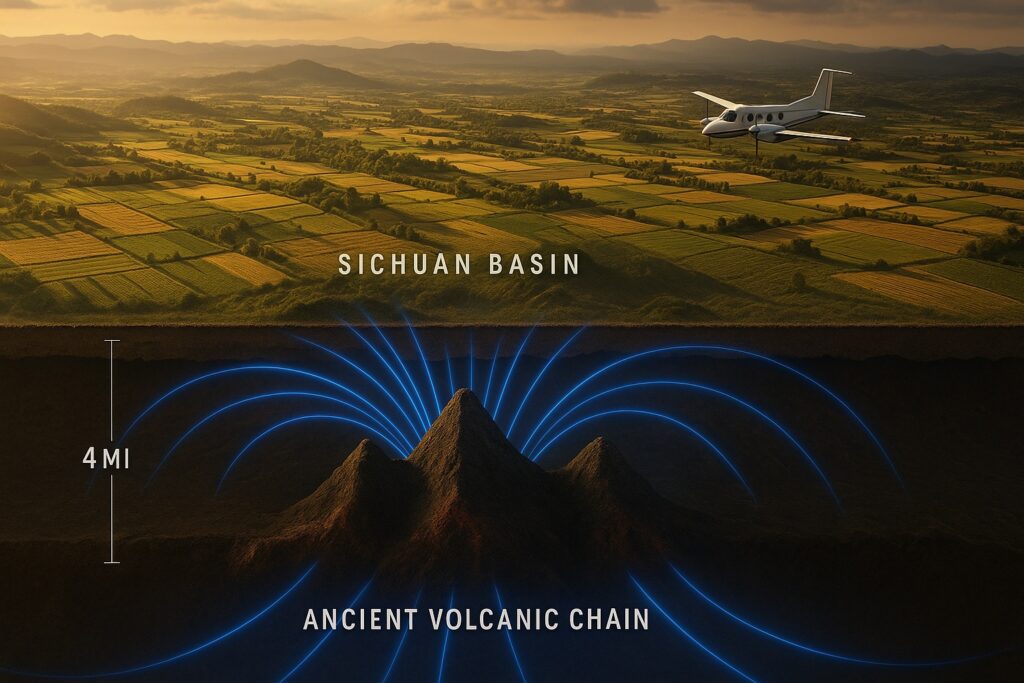
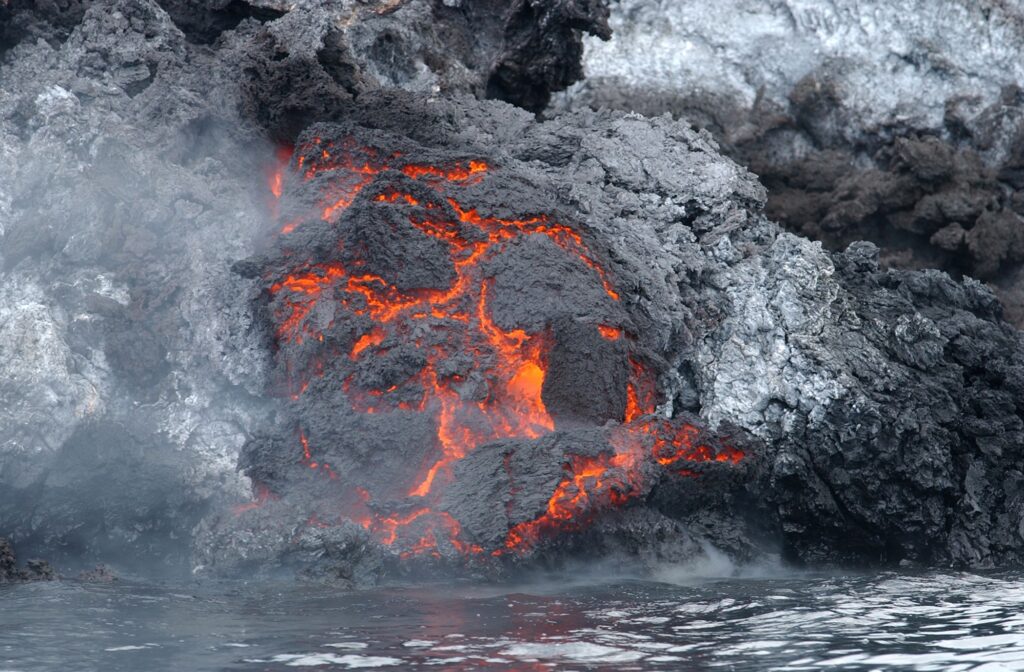
The heat and pressure from this collision generated massive amounts of magma that rose to the surface, creating a curved chain of volcanoes above the subduction zone.
But here’s where it gets strange.
Most volcanic arcs form narrow belts along continental margins — think of the Cascade Range in North America, which forms a single mountain chain above the Juan de Fuca Plate.
The Chinese volcanic chain breaks all the rules.
Scientists believe they’ve found the answer in a rare phenomenon called flat-slab subduction. Instead of diving steeply into Earth’s mantle, the oceanic plate slid horizontally beneath the continent at a shallow angle for hundreds of miles before finally sinking.
This unusual process created two distinct volcanic ridges: one near the continental edge where the plate first subducted, and another deep inland where it finally descended into the mantle.
“This fossil arc was formed during the assembly and breakup of Rodinia,” the researchers explained, placing the volcanic system within one of the most active tectonic episodes in Earth’s history.
The discovery’s implications extend far beyond understanding rock formations.
Volcanic activity plays a crucial role in Earth’s carbon cycle — eruptions release carbon dioxide into the atmosphere, while the weathering of volcanic rocks removes it. The sheer scale of this ancient volcanic system suggests it could have significantly influenced global climate during the Neoproterozoic era.
This was a critical period in Earth’s history.
Scientists have long debated what triggered the “Snowball Earth” events, when ice sheets potentially extended close to the equator. The massive volcanic activity from this newly discovered chain, combined with the erosion of volcanic mountain ranges, might have played a role in these dramatic climate shifts.
Peter Cawood, an Earth scientist at Monash University who wasn’t involved in the study, told Live Science the discovery presents “an exciting new set of data in a region that has been difficult to study.”
He added that it “shows that the volume of magmatic activity along this boundary may be considerably greater than previously realized.”
The breakthrough came through cutting-edge technology rarely used at this scale.
Airborne magnetic sensors acted like X-ray vision, detecting variations in the magnetic properties of rocks buried beneath several kilometers of sedimentary deposits. Different rock types contain varying amounts of magnetic minerals, allowing geophysicists to map underground formations without ever touching them.
The iron-rich volcanic rocks produced a magnetic signature impossible to ignore — a 430-mile-long anomaly stretching from northeast to southwest across the Yangtze Block.
But detecting the anomaly was just the beginning.
The team needed physical proof, which meant drilling deeper than most geological surveys ever attempt. Their seven boreholes, reaching depths of up to 6.5 kilometers, brought up rock samples that hadn’t seen daylight in 800 million years.
The Sichuan Basin discovery suggests that many more ancient volcanic systems might be hiding beneath our feet, waiting to be discovered.
Traditional geological surveys have focused on volcanic arcs near continental margins, but this finding proves that massive volcanic systems can exist hundreds of miles inland — if you know where and how to look.
For geologists, the Sichuan Basin has transformed from an energy resource site into a natural archive of Earth’s ancient history. The preservation of these structures, buried and protected for nearly a billion years, provides an unprecedented window into deep Earth processes.
This discovery reminds us how much of Earth’s history remains hidden.
We’re walking above layers of geological drama — ancient volcanoes, lost oceans, and vanished continents — buried beneath seemingly ordinary landscapes. The Sichuan Basin’s secret volcanic chain lay dormant and undiscovered for 800 million years, despite being one of the largest volcanic systems ever found inland.
As researchers continue probing Earth’s depths with increasingly sophisticated technology, we’re likely to uncover more structures that challenge our understanding of how our planet formed and evolved.
The question isn’t whether more surprises await discovery.
It’s what those discoveries will tell us about Earth’s past — and potentially its future.
The complete findings are published in the Journal of Geophysical Research: Solid Earth, detailing how this massive volcanic system remained hidden for nearly a billion years before modern technology finally revealed its secrets.