Physical Address
304 North Cardinal St.
Dorchester Center, MA 02124
Physical Address
304 North Cardinal St.
Dorchester Center, MA 02124

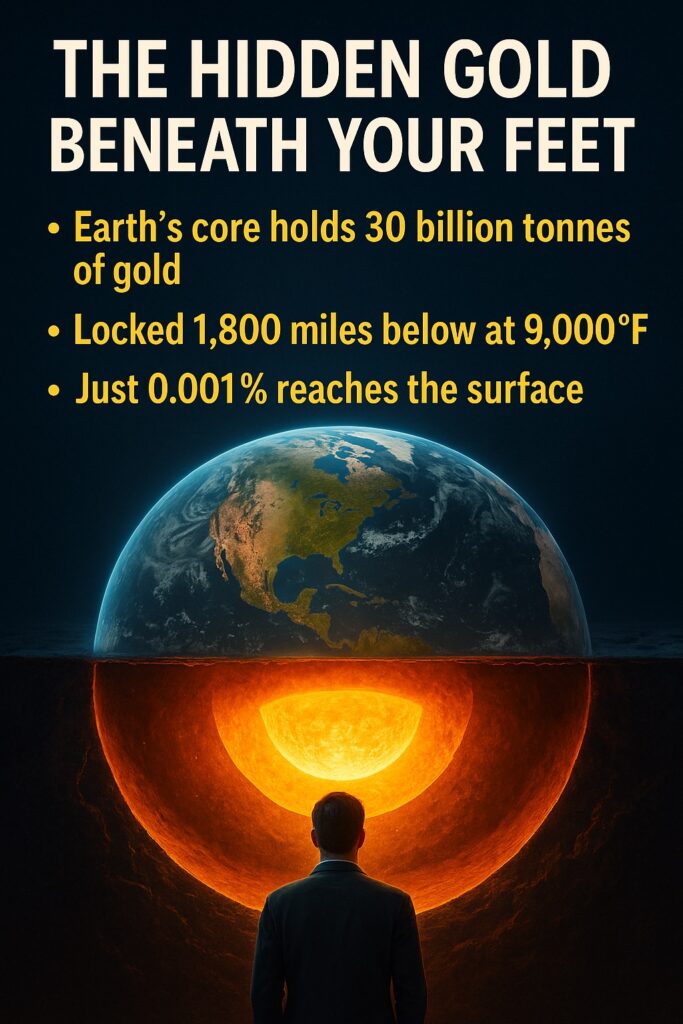
Right now, you’re standing on top of the world’s largest gold mine.
But there’s a catch — 99.999% of it is trapped 1,800 miles beneath your feet in Earth’s molten core, where temperatures exceed 9,000°F.
New research from the University of Göttingen just discovered something remarkable: Earth’s core is literally leaking gold. Scientists found traces of precious metals in Hawaiian volcanic rocks that could only have traveled up from the planet’s deepest depths.
Here’s what makes this discovery so extraordinary.
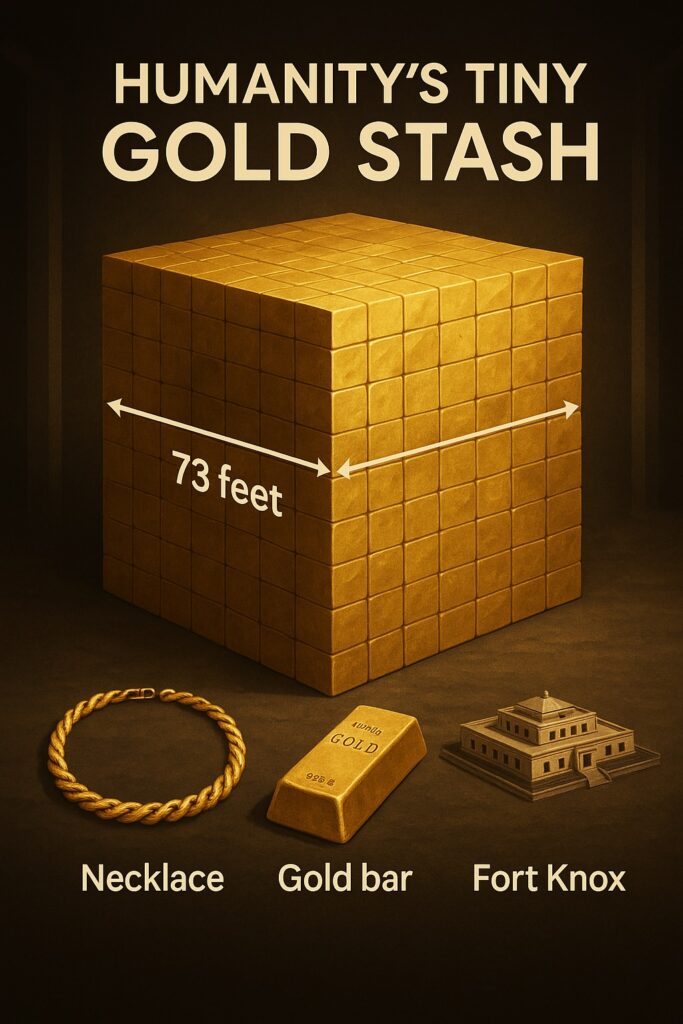
All the gold humanity has ever mined — about 216,000 tonnes — would fit in a cube just 73 feet on each side. That’s every piece of jewelry, every gold bar in Fort Knox, every electronic component using gold in your smartphone.
It’s basically pocket change.
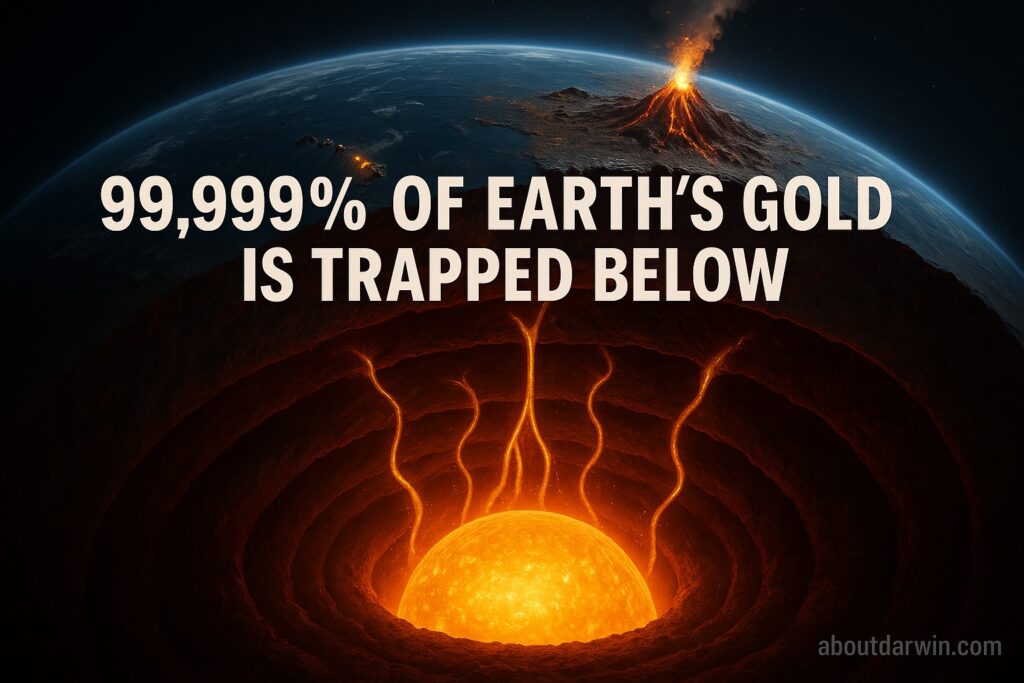
Earth’s core contains an estimated 30 billion tonnes of gold. That’s enough to coat every bit of land on the planet in a layer of gold almost half a meter thick.
At today’s prices, we’re talking about €2.77 million billion worth of gold.
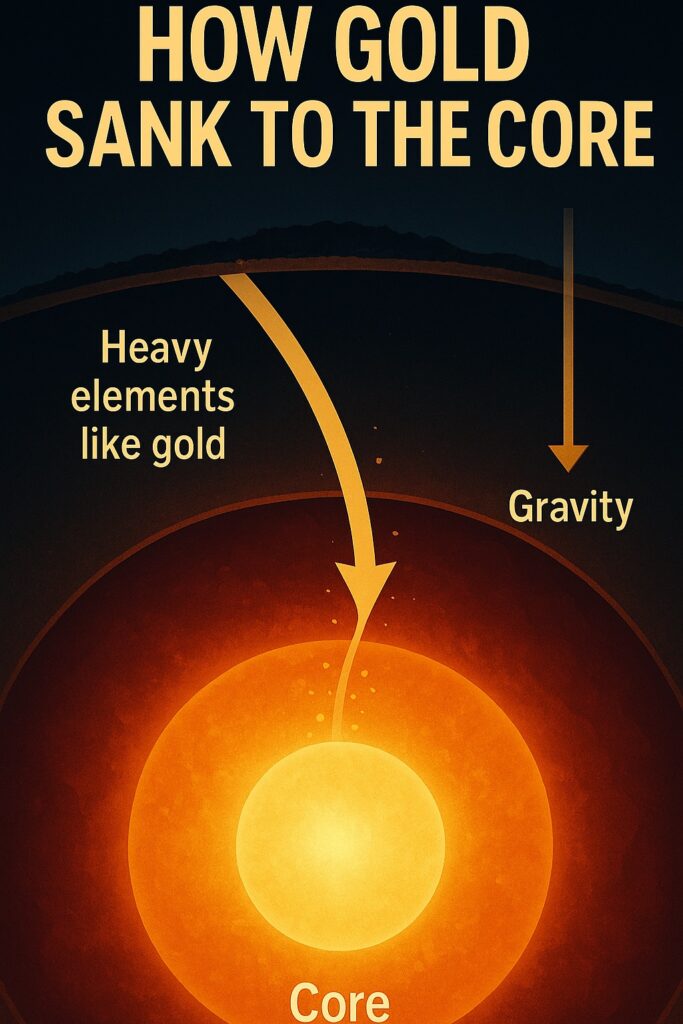
When Earth formed 4.5 billion years ago, it was essentially a giant ball of molten rock.
Heavy elements like gold are “siderophiles” — they love bonding with iron. As the planet cooled and differentiated, these dense metals sank straight to the center alongside iron in what scientists call the “iron catastrophe.”
The lighter silicate minerals floated upward to form the crust we walk on today.
This process was remarkably efficient. More than 99% of Earth’s gold ended up locked in the core, leaving only trace amounts in the crust for humans to discover.
Darwin observed similar geological processes during his travels, noting how earthquakes and volcanic activity slowly reshape Earth’s surface — though he never imagined the treasures hidden far beneath.
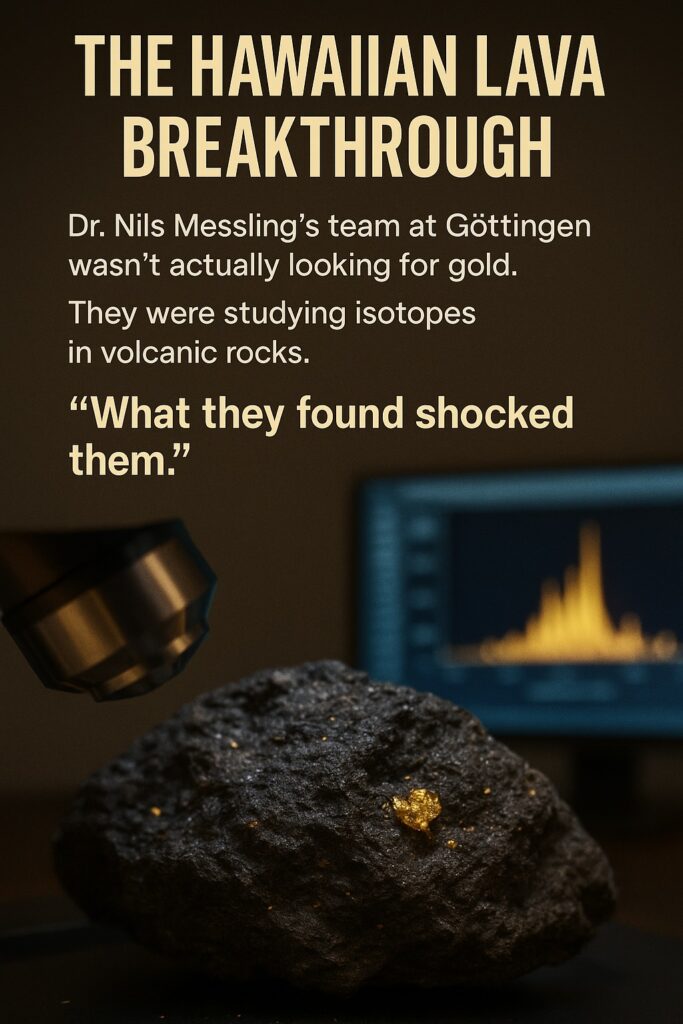
Dr. Nils Messling’s team at Göttingen wasn’t actually looking for gold.
They were studying ruthenium isotopes in volcanic rocks from Hawaii, the Galápagos, and other ocean islands.
What they found shocked them.
The rocks contained unusually high levels of ruthenium-100, an isotope that’s more abundant in Earth’s core than in the mantle.
“When the first results came in, we realized that we had literally struck gold,” Messling said in the study.
This isotope acts like a chemical fingerprint. Its presence proves that material from the core-mantle boundary — 2,900 kilometers below the surface — is slowly making its way up through volcanic hotspots.
The discovery reveals Earth’s core isn’t the isolated prison scientists once believed.
Instead, there’s a slow but steady exchange happening at the core-mantle boundary.
Super-heated plumes of mantle material — we’re talking hundreds of quadrillion metric tonnes of rock — rise from this boundary toward the surface. These plumes carry tiny amounts of core material with them, including gold and other precious metals.
When these plumes reach the surface, they form volcanic islands like Hawaii.
The amount of core material in any single volcanic rock is minuscule — less than 0.3% according to the research.
But multiply that by millions of years of volcanic activity, and suddenly Earth’s surface gold deposits start to make sense.
Before you grab a shovel, let’s talk logistics.
The deepest humans have ever drilled is the Kola Superdeep Borehole in Russia, which reached 12,262 meters — about 0.2% of the distance to the core.
At that depth, temperatures already exceeded 350°F.
The core-mantle boundary sits at 2,900 kilometers deep. The outer core itself is liquid iron and nickel at temperatures around 9,000°F — hot enough to melt any drilling equipment we could possibly create.
Even if we could somehow reach it, extracting the gold would likely destabilize Earth’s magnetic field, which protects us from deadly solar radiation.
Professor Matthias Willbold put it bluntly: “The gold is there, but it’s staying there.”
If Earth’s core is off-limits, there’s another option.
NASA is currently studying the asteroid Psyche, which appears to be the exposed core of a destroyed planet.
Unlike Earth, Psyche’s metals aren’t buried under thousands of miles of rock.
Scientists estimate Psyche could contain precious metals worth $10,000 quadrillion — though flooding the market with that much gold would obviously crash prices.
Several companies are already developing asteroid mining technology. It might sound like science fiction, but it’s likely more feasible than drilling to Earth’s core.
The Göttingen research suggests that new gold deposits are still forming through volcanic activity.
The bad news? The process takes millions of years.
“Whether these processes that we observe today have also been operating in the past remains to be proven,” Messling explained.
But the discovery does explain why certain volcanic regions have historically been rich in precious metals.
It also opens entirely new perspectives on how Earth’s interior dynamics work. The planet isn’t a static layer cake — it’s a slowly churning system where even the deepest materials eventually find their way to the surface.
Earth’s core contains more gold than humans could ever use — enough to fundamentally transform our relationship with this precious metal.
But it’s trapped behind 1,800 miles of solid rock and a sea of molten iron at temperatures that would vaporize any mining equipment.
For now, we’ll have to make do with the 0.001% of Earth’s gold that geology has kindly made accessible.
Unless we figure out asteroid mining first.
The research was published in Nature by scientists from the University of Göttingen.