Physical Address
304 North Cardinal St.
Dorchester Center, MA 02124
Physical Address
304 North Cardinal St.
Dorchester Center, MA 02124

The Big Y-700 test from FamilyTreeDNA represents the most comprehensive Y-DNA testing option available for genealogists seeking to unlock their paternal ancestry. By analyzing over 700 STR markers and more than 500,000 SNPs, this advanced test delivers unprecedented resolution for tracing direct male lineage back through thousands of years. Whether you are struggling with a genealogical brick wall, researching a surname project, or simply curious about your deep ancestral origins, understanding how the Big Y-700 works can transform your family history research.
Unlike standard DNA tests that provide broad ethnicity estimates, the Big Y-700 focuses specifically on the Y chromosome passed exclusively from father to son. This specialized approach enables testers to identify their precise haplogroup, connect with genetic matches across the genealogical timeframe, and potentially break through research barriers that traditional paper records cannot solve. In this guide, we will explore everything you need to know about this powerful genetic genealogy tool, including when to choose it, how to interpret results, and whether the investment is worthwhile for your research goals.
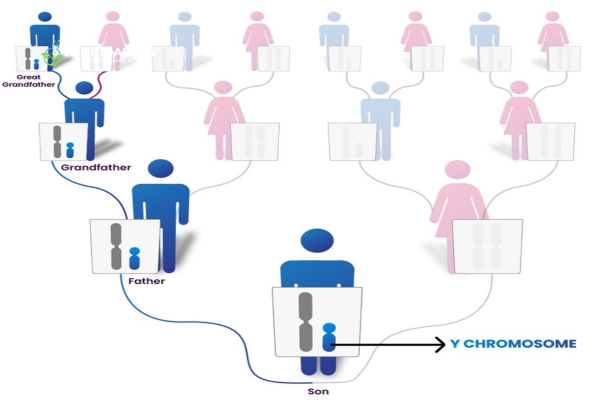
Y-DNA testing analyzes the Y chromosome, one of the two sex chromosomes that determines male biological sex. Because the Y chromosome passes virtually unchanged from father to son across generations, it serves as a genetic signature for tracing direct paternal lineage. This unique inheritance pattern means that males share nearly identical Y-DNA with their fathers, grandfathers, and all direct male ancestors extending back thousands of years.
The testing process examines specific locations on the Y chromosome called markers. These markers come in two primary types: STRs (Short Tandem Repeats) and SNPs (Single Nucleotide Polymorphisms). STR testing counts the number of repeats at specific DNA locations, which is useful for finding recent genealogical connections within the past several hundred years. SNP testing identifies individual genetic mutations that occurred thousands of years ago, helping to place testers on the human haplogroup tree and trace ancient migration patterns.
Also Read: What Information Does DNA Tests Give?
The Big Y-700 test represents the pinnacle of Y-DNA testing technology available through FamilyTreeDNA. Building upon earlier versions including the Big Y-500, this next-generation sequencing test examines 700 STR markers and over 500,000 SNPs across the Y chromosome with 70x coverage depth. This comprehensive analysis enables precise haplogroup placement and the discovery of previously unknown genetic variants that may be unique to your specific paternal lineage.
The technical specifications distinguish the Big Y-700 from all other Y-DNA tests on the market. With 70x coverage meaning each location is read 70 times for accuracy, testers receive highly reliable results that can identify even rare genetic mutations. The test examines both known SNPs that define established haplogroups and novel variants that may lead to the discovery of new subclades. This combination of STR and SNP analysis provides both recent genealogical connections and deep ancestral information spanning tens of thousands of years.
Understanding the distinction between STR and SNP markers is essential for making informed decisions about Y-DNA testing. These two marker types serve different purposes in genetic genealogy and provide complementary information about your paternal ancestry.
| Feature | STR (Short Tandem Repeat) | SNP (Single Nucleotide Polymorphism) |
|---|---|---|
| What it measures | Number of repeats at specific DNA segments | Single letter changes in DNA sequence |
| Mutation rate | Fast – changes every few generations | Slow – typically once every few thousand years |
| Timeframe | Recent genealogy (last 10-20 generations) | Deep ancestry (hundreds to thousands of years) |
| Primary use | Finding matches, calculating genetic distance | Determining haplogroup, tracing ancient migrations |
| Test levels | Y-37, Y-67, Y-111, Big Y-700 (700 STRs) | Big Y-700 (500,000+ SNPs), individual SNP packs |
| Matching | Matches within genealogical timeframe | Haplogroup placement, ancient connections |
| TMRCA estimates | Accurate within several hundred years | Broad estimates across millennia |
STR markers mutate relatively quickly, making them ideal for identifying relatives within the genealogical timeframe. When you compare STR results with another tester, the number of differences between your markers indicates genetic distance, which helps estimate how many generations back you share a common ancestor. This information proves invaluable for verifying paper trails and connecting with distant cousins who share your surname.
SNP markers, by contrast, mutate so slowly that when a mutation occurs, it typically defines a new branch on the human haplogroup tree that persists for thousands of years. Each SNP represents a point in time when a specific man passed a unique genetic change to his descendants. By testing hundreds of thousands of SNPs, the Big Y-700 can place you precisely on this tree, identifying your terminal SNP, which represents the most recent known branch of your paternal lineage.
FamilyTreeDNA offers several Y-DNA testing levels, each designed for different research needs and budgets. Understanding these options helps you choose the right starting point and plan potential upgrade paths as your research progresses.

| Test | STR Markers | SNPs Analyzed | Price | Best For |
|---|---|---|---|---|
| Y-37 | 37 | None | $119 | Starter testing, surname projects, budget-conscious researchers |
| Y-67 | 67 | None | $239 | Intermediate testing, improved matching precision |
| Y-111 | 111 | None | $359 | Advanced STR matching, closer relationship verification |
| Big Y-700 | 700 | 500,000+ | $449 | Deep ancestry, haplogroup discovery, surname projects, brick wall research |
The Y-37 test serves as an excellent entry point for those new to Y-DNA testing or working within a limited budget. It provides enough STR markers to place you within surname projects and identify matches within the past several hundred years. However, 37 markers offer limited resolution for distinguishing between closely related lineages, and you may encounter ambiguous matches that require higher marker testing to resolve.
Upgrading to Y-111 provides significantly improved matching capability, particularly for distinguishing between branches of a surname that split within the past several centuries. The additional markers help calculate more accurate genetic distances and reduce false positive matches. However, even Y-111 tests only STR markers and cannot provide the deep ancestral information or haplogroup precision that SNP testing delivers.
The Big Y-700 test at $449 from FamilyTreeDNA combines the benefits of extended STR testing with comprehensive SNP analysis. While the upfront cost exceeds lower marker tests, the Big Y-700 eliminates the need for sequential upgrades and provides immediate access to the full range of Y-DNA information. For serious researchers and those committed to surname projects, the Big Y-700 often proves more economical than upgrading through multiple test levels.
Autosomal DNA tests and Y-DNA tests serve fundamentally different purposes in genetic genealogy. Autosomal testing examines the 22 pairs of non-sex chromosomes inherited from both parents, providing ethnicity estimates and matches from all ancestral lines within the past five to seven generations. Tests from AncestryDNA, 23andMe, and MyHeritage fall into this category, offering broad ancestral overviews but limited specificity for any single lineage.
Y-DNA testing exclusively traces the paternal line, offering precision that autosomal tests cannot match for this specific lineage. While autosomal DNA recombines with each generation, making it difficult to trace specific ancestors beyond several generations, Y-DNA passes unchanged from father to son across hundreds of generations. This stability enables Y-DNA to connect testers across the genealogical timeframe and beyond, often identifying common ancestors from centuries or even millennia ago.
For comprehensive genealogical research, both test types provide complementary information. Autosomal testing excels at finding recent relatives across all family lines and providing broad ethnicity breakdowns. Y-DNA testing specifically illuminates the direct paternal lineage with precision impossible through autosomal analysis. Genealogists working on surname projects or seeking to verify direct male lines should consider the Big Y-700 even if they have already completed autosomal testing.
Also Read: How to Organise Your DNA Matches: Step-by-Step Guide
Y-DNA testing offers unique advantages for specific research scenarios. Understanding who benefits most helps determine whether the Big Y-700 test aligns with your genealogical goals.

Women cannot take Y-DNA tests themselves but can participate by having a male relative from their paternal line test. A father, brother, paternal uncle, or male cousin with the same surname can provide the Y-DNA signature for a woman’s paternal lineage. This proxy testing enables women to benefit from Y-DNA analysis even though they do not carry Y chromosomes.
FamilyTreeDNA provides several proprietary tools that help Big Y-700 testers interpret their results and connect with genetic matches. Understanding these tools maximizes the value of your test investment.
The Discover tool represents one of FamilyTreeDNA’s most innovative features for Big Y-700 testers. This interactive interface visualizes your placement on the haplogroup tree, showing your terminal SNP, ancestral haplogroups, and the time estimates for when each branch formed. The tool displays ancient connections, showing how your lineage relates to archaeological finds and ancient DNA samples from historic populations.
Discover provides estimated dates for when each SNP mutation occurred in your lineage, helping you understand the timeline of your paternal ancestry. The tool also identifies notable connections, such as famous historical figures who share your haplogroup and ancient samples from archaeological sites that match your genetic signature. This feature transforms abstract SNP data into a narrative about your deep ancestral journey.
The Time Tree feature visualizes the genetic relationships between you and your Big Y-700 matches, displaying branches based on shared SNPs and estimating TMRCA (Time to Most Recent Common Ancestor). Unlike traditional genealogy trees that follow surname inheritance, Time Tree displays the genetic reality of how testers relate based on their actual DNA mutations.
Group Time Trees extend this concept for surname projects and research groups. Project administrators can view all project members on a single tree, identifying genetic branches and subclades that may correspond to different family lines. This visualization helps surname projects organize members by genetic lineage rather than surname alone, revealing connections that paper records may not document.
Understanding TMRCA estimates is crucial for interpreting Time Tree results. These estimates calculate when you and a match likely shared a common ancestor based on the number of SNP differences between your results. While not precise to specific generations, TMRCA helps distinguish between recent genealogical connections and more distant relationships that may predate surname adoption.
The Block Tree organizes your Big Y-700 matches by their terminal SNPs, showing the hierarchical structure of your haplogroup and its subclades. This view helps identify which matches share your exact terminal SNP versus those on closely related branches. Matches sharing your terminal SNP likely share a common ancestor within the genealogical timeframe and warrant priority contact for collaboration.
The Classic Tree provides a more traditional view of Y-DNA matches, organizing them by genetic distance based on STR markers. This view complements the Block Tree by showing recent relationships that STR matching captures more effectively than SNP analysis alone. Together, these tools provide a comprehensive picture of both your recent genealogical connections and deep ancestral placement.
Surname projects represent one of the most powerful applications of Big Y-700 testing. These collaborative research efforts bring together individuals sharing a surname or genetic lineage to map the connections between different family branches. The Big Y-700 enables project administrators to create precise genetic trees that often reveal relationships predating surviving paper records.
Effective surname projects employ strategic testing approaches. Starting with lower marker tests like Y-37 helps identify which genetic lineages participants belong to before investing in Big Y-700 upgrades. Once basic lineages are established, strategic Big Y-700 testing of representative members from each branch helps define the project’s genetic structure. This targeted approach maximizes information while managing costs.
The Big Y-700 proves particularly valuable for surname projects dealing with common surnames or those with multiple unrelated origins. By identifying specific SNP signatures associated with each lineage, the test can definitively sort participants into genetic groups regardless of spelling variations or surname adoption. This genetic sorting often resolves questions that centuries of traditional research could not answer.
Determining the optimal timing for a Big Y-700 upgrade depends on your research goals, current testing status, and genealogical situation. Several scenarios indicate that upgrading from lower marker tests provides significant value.
If you previously tested with the original Big Y or Big Y-500, upgrading to Big Y-700 provides additional STR markers and improved SNP coverage. The upgrade analyzes additional regions of the Y chromosome not covered in earlier versions, potentially identifying new variants and providing more precise haplogroup placement. FamilyTreeDNA periodically offers upgrade pricing that makes this transition more affordable for earlier testers.
At $449, the Big Y-700 represents a significant investment in your genealogical research. Evaluating whether this expenditure aligns with your goals requires considering both the unique information it provides and the alternatives available at lower price points.
The Big Y-700 delivers value through several unique capabilities unavailable through any other DNA test. No other test provides simultaneous analysis of 700 STR markers and 500,000 SNPs. No other test offers the haplogroup precision necessary for deep ancestry research. No other test enables the level of surname project integration that the Big Y-700 provides through FamilyTreeDNA’s specialized tools.
For serious genealogists working on paternal lineage, the Big Y-700 often proves more economical than sequential upgrades. Starting with Y-37 ($119), then upgrading to Y-111 ($359), and finally to Big Y-700 costs significantly more than beginning with the Big Y-700. Additionally, the Big Y-700 provides immediate access to all features rather than waiting through multiple upgrade cycles.
However, not every researcher needs the comprehensive analysis Big Y-700 provides. If your goals are limited to recent genealogy within the past few generations, or if you are uncertain about the surname you are researching, starting with Y-37 may be more prudent. You can always upgrade later if your research justifies the additional investment. The Big Y-700 provides the greatest value for those committed to deep paternal research, surname projects, or solving specific brick wall problems.
Y-DNA testing, like all genetic testing, involves important privacy and ethical considerations. Understanding these issues helps testers make informed decisions about their participation in genetic genealogy.
Informed consent requires understanding what happens to your DNA data after testing. FamilyTreeDNA maintains a database of Y-DNA results for matching purposes, and your results will be compared against all other testers in the system. While this matching capability provides the primary value of testing, it means your genetic information becomes part of a searchable database. Reviewing the company’s privacy policy and terms of service before testing ensures you understand how your data will be used and stored.
Data security represents another critical consideration. DNA data contains sensitive personal information that could theoretically be misused if accessed by unauthorized parties. FamilyTreeDNA implements security measures to protect tester data, but no system is completely immune to breaches. Understanding the company’s security practices and your rights regarding data deletion helps you make an informed decision about testing.
One specific consideration for Y-DNA testing involves the potential discovery of non-paternal events (NPEs), also called misattributed paternity. Y-DNA testing can reveal that a tester’s biological father differs from the documented father, either through recent adoption, infidelity, or historical surname changes. While such discoveries can provide valuable genealogical truth, they may also disrupt family narratives and relationships. Testers should consider how they might respond to unexpected results before proceeding with testing.
Interpreting Big Y-700 results requires understanding several key components that together paint a comprehensive picture of your paternal ancestry.
Your haplogroup represents your placement on the human Y-DNA tree, tracing back to the common ancestor of all males alive today. The Big Y-700 identifies your terminal SNP, the most specific known branch of this tree that defines your lineage. As more people test and new SNPs are discovered, your placement may become even more precise, potentially splitting your current haplogroup into finer subclades.
Private variants are SNPs unique to your test that have not yet been observed in other testers. These represent recent mutations in your paternal line that may eventually define new haplogroup branches as more relatives test. Tracking private variants helps identify close relatives, as sharing a private variant indicates a very recent common ancestor.
Named variants are SNPs that have been observed in multiple testers and assigned formal haplogroup designations. These define established branches of the Y-DNA tree and help place you within the broader human genetic landscape. The Big Y-700 tests hundreds of thousands of named variants, ensuring comprehensive haplogroup placement.
STR matches from your 700 tested markers help identify relatives within the genealogical timeframe. The number of markers that differ between you and a match indicates genetic distance, which correlates with the number of generations since your common ancestor lived. Closer genetic distances suggest more recent relationships warranting immediate genealogical investigation.
Also Read: DNA Matches Aren’t Related? What Does That Mean?
Women cannot take the Big Y-700 test because they do not possess Y chromosomes. The test is exclusively for males tracing their direct paternal lineage. However, women can learn about their paternal ancestry by having a male relative from their father’s line, such as a father, brother, or paternal uncle, take the test on their behalf.
The Big Y-700 offers superior accuracy for paternal lineage analysis due to its 70x coverage and comprehensive testing of over 500,000 SNPs. The high coverage depth means each genetic location is read 70 times, virtually eliminating errors. For paternal ancestry specifically, no commercially available test provides more detailed or accurate results than the Big Y-700.
Yes, if you are specifically interested in your paternal lineage. Autosomal tests provide broad ancestry information across all family lines but cannot trace any specific lineage with the precision of Y-DNA testing. The Big Y-700 provides detailed haplogroup information and connects you with genetic matches along your direct paternal line that autosomal tests cannot identify.
The Big Y-700 does not provide ethnicity percentages, maternal lineage information, or health-related genetic data. It exclusively analyzes the Y chromosome for paternal ancestry. For comprehensive ethnicity estimates, you would need an autosomal test from providers like AncestryDNA or 23andMe. For maternal lineage, mitochondrial DNA testing is required.
The Big Y-700 can trace your paternal lineage back tens of thousands of years through SNP analysis, revealing your ancient haplogroup origins and migration paths. For genealogical purposes, the test can identify common ancestors within the past several hundred years through both STR and SNP matching. The precise timeframe depends on how many relatives have tested and the mutation rates of your specific lineage.
TMRCA stands for Time to Most Recent Common Ancestor. It represents the estimated number of years or generations since you and a genetic match shared a common paternal ancestor. The Big Y-700 uses the number of SNP differences between testers to calculate TMRCA estimates, helping distinguish between recent genealogical connections and more distant relationships that may predate surname adoption or surviving records.
The Big Y-700 test from FamilyTreeDNA stands as the most comprehensive Y-DNA testing option available for genetic genealogy research. By analyzing 700 STR markers and over 500,000 SNPs with 70x coverage, this test provides unparalleled resolution for tracing paternal ancestry across both recent genealogical timeframes and deep prehistoric periods. The $449 investment delivers value through precise haplogroup placement, extensive matching capabilities, and access to specialized tools like the Discover interface and Time Tree visualizations.
For males committed to understanding their direct paternal lineage, the Big Y-700 offers capabilities that no other DNA test can match. Whether you are participating in a surname project, attempting to overcome a genealogical brick wall, researching adoption or unknown parentage, or simply curious about your deep ancestral origins, this test provides the genetic information necessary to advance your research. While the cost exceeds lower marker alternatives, the comprehensive analysis and elimination of sequential upgrades often makes the Big Y-700 the most economical choice for serious researchers.
As genetic genealogy continues evolving and databases grow, Big Y-700 results become increasingly valuable. New matches, refined haplogroup placements, and improved analysis tools continuously enhance the information extracted from your test. For those seeking definitive answers about their paternal heritage, the Big Y-700 represents not merely a test, but an ongoing resource for understanding your place in the human genetic story.