Physical Address
304 North Cardinal St.
Dorchester Center, MA 02124
Physical Address
304 North Cardinal St.
Dorchester Center, MA 02124

Shared DNA matches have revolutionized how we explore our family history in 2026. When I first received my DNA test results, I was overwhelmed by the list of hundreds of potential relatives. Understanding which matches matter and how they connect to each other transformed my genealogical research from frustrating guesswork into a systematic discovery process. This guide to shared DNA matches will show you exactly how to leverage these connections to build a more complete picture of your heritage.
The concept is straightforward yet powerful: when two people share DNA with you and with each other, they form a cluster that points to a specific branch of your family tree. By analyzing these clusters strategically, you can identify which matches belong to your mother’s side versus your father’s side, solve mysteries about unknown ancestors, and break through brick walls that traditional records cannot penetrate. Whether you are just starting with genetic genealogy or looking to sharpen your existing skills, mastering shared DNA matches will accelerate your discoveries.
In this comprehensive guide, I cover everything from the basics of how shared DNA matches work to advanced techniques like triangulation and Shared Matches of Matches (SMOM). You will learn platform-specific instructions for AncestryDNA, 23andMe, MyHeritage, FamilyTreeDNA, and Living DNA. I also explain centimorgans and shared segments in plain language, provide practical strategies for contacting matches, and address common frustrations like missing matches and endogamous populations. By the end, you will have the knowledge to turn your DNA match list into a roadmap for building an accurate, extensive family tree.
Shared DNA matches, often called “In Common With” (ICW) matches, are individuals who appear in the DNA match lists of both you and another tested person. When you and a match both share DNA with a third person, that third person becomes a shared match. This shared connection strongly suggests that all three of you descend from a common ancestor, though the exact relationship path may differ between each pair. Understanding this clustering effect is fundamental to organizing your genetic genealogy research.
At the genetic level, shared matches indicate that multiple people inherited identical DNA segments from a shared ancestor. These segments, measured in centimorgans (cM), represent stretches of your autosomal DNA that remained unchanged through generations of inheritance. The more centimorgans you share with a match, the closer your likely relationship. When you find a group of matches who all share DNA with each other and with you, you have identified a genetic cluster pointing to a specific family line.
The practical value of shared matches lies in their ability to sort your DNA match list into family branches. Without this tool, a list of hundreds or thousands of matches feels like an impossible puzzle. By identifying which matches share connections with each other, you can begin assigning them to your maternal grandmother’s line, your paternal grandfather’s branch, or more distant ancestral lines. This organizational framework transforms raw DNA data into actionable genealogical insights. To understand the specific DNA percentages involved, see our detailed breakdown of how much DNA siblings, cousins, and other relatives typically share.
Also Read: Ultimate Mirror Tree Guide to Understanding DNA
Before diving deeper into shared matches, you need to understand centimorgans (cM). A centimorgan is a unit of genetic linkage that measures the probability of DNA recombination between two points on a chromosome. In practical terms, it quantifies how much DNA you share with a match. One centimorgan represents approximately one million base pairs of DNA. Higher cM values indicate closer relationships, while lower values suggest more distant connections.
DNA testing companies report shared DNA as both total centimorgans and the number of shared segments. The total cM gives you an overall measure of genetic relationship, while segment count and length provide additional clues. Longer segments generally indicate more recent common ancestors, while many small segments might suggest either distant shared ancestry or population-level genetic similarity. Most genealogists focus on matches sharing at least one segment of 7 cM or larger, as smaller segments become increasingly unreliable indicators of traceable common ancestry.
Here is a reference chart showing typical cM ranges for common relationships:
| Relationship | Average Shared cM | Range |
|---|---|---|
| Parent/Child | 3,475 cM | 3,300 – 3,700 |
| Full Siblings | 2,625 cM | 2,200 – 3,100 |
| Half Siblings | 1,780 cM | 1,300 – 2,150 |
| Grandparent/Grandchild | 1,750 cM | 1,400 – 2,100 |
| Aunt/Uncle/Niece/Nephew | 1,750 cM | 1,300 – 2,050 |
| First Cousin | 875 cM | 550 – 1,300 |
| First Cousin Once Removed | 440 cM | 220 – 700 |
| Second Cousin | 235 cM | 100 – 400 |
| Second Cousin Once Removed | 125 cM | 50 – 220 |
| Third Cousin | 75 cM | 30 – 150 |
| Fourth Cousin | 35 cM | 10 – 85 |
| Fifth Cousin | 25 cM | 5 – 50 |
| Sixth Cousin | 18 cM | 0 – 35 |
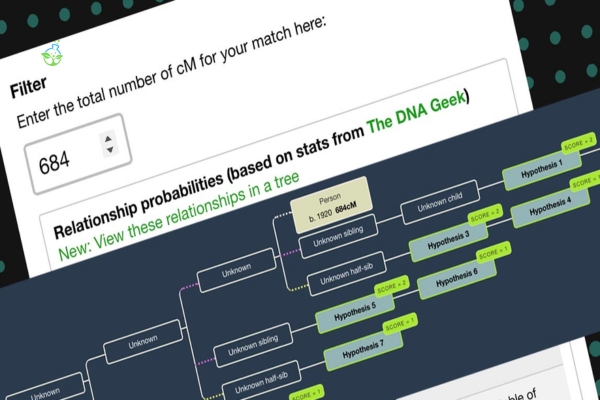
These ranges represent statistical averages compiled through the Shared cM Project 4.0, a community-driven database of actual DNA match data. Individual results may vary due to the random nature of DNA inheritance. For example, you might share 1,100 cM with one first cousin but only 650 cM with another. This variation occurs because recombination shuffles DNA unpredictably each generation. When your results fall outside typical ranges, use tools like the Shared cM Project probability calculator to explore possible relationship alternatives.
Finding shared DNA matches requires navigating to the correct section within your chosen DNA testing platform. Each company labels and organizes this feature differently, though the underlying concept remains the same. Below are the current steps for accessing shared matches on the five major testing companies as of 2026.
AncestryDNA displays shared matches under the “Shared Matches” tab on each match’s detail page. Navigate to your DNA match list, select any match, and click the Shared Matches tab to see everyone who shares DNA with both of you. Ancestry limits shared matches to those sharing 20 cM or more with your selected match. This threshold means you will not see more distant shared connections, which helps reduce false positives but also limits research possibilities.
In 2026, Ancestry introduced Pro Tools features including Enhanced Shared Matches. These tools allow you to view shared matches across multiple selected matches simultaneously, creating more sophisticated cluster analysis. To access these features, navigate to DNA Matches, select multiple matches using the checkboxes, and use the “View shared matches” option. This batch processing saves significant time when working with large match lists. For more detailed platform information, see our AncestryDNA review.
23andMe refers to shared matches as “Relatives in Common.” Access this feature by selecting any DNA match from your list, then scrolling down to the “Relatives in Common” section. 23andMe shows all matches who share DNA with both you and your selected relative, regardless of how much DNA they share with each other. This broader view can reveal connections that Ancestry’s threshold limits might hide.
The 23andMe interface also displays the percentage of DNA shared between you and each relative in common, helping you assess which connections might be most relevant for your research. Note that 23andMe calculates shared DNA differently than other companies, often resulting in slightly different cM totals for the same relationship. When comparing across platforms, use percentage shared as a more consistent reference point. Our comparison of 23andMe and AncestryDNA explains these differences in detail.
MyHeritage DNA offers robust shared matching capabilities under their “Shared DNA Matches” section. Click on any match from your DNA match list, then scroll down to view the shared matches. MyHeritage includes shared matches who share as little as 5 cM with the selected match, giving you a wider view of potential connections than Ancestry’s 20 cM threshold.
MyHeritage also provides a chromosome browser that integrates with shared match data, allowing you to visualize exactly which DNA segments you share. This visual representation helps identify triangulated segments, where you and two matches share the exact same DNA stretch, confirming descent from a common ancestor. The combination of shared matching and chromosome browsing makes MyHeritage particularly powerful for advanced genetic genealogy research.
FamilyTreeDNA labels shared matches as “In Common With” or ICW. From your Family Finder match list, select any match and click the “In Common With” button. FTDNA displays all matches who share DNA with both you and your selected match. The company offers both total shared cM and longest block measurements, giving you two data points for assessing relationship closeness.
FamilyTreeDNA also provides a chromosome browser accessible directly from the ICW results. This integration lets you compare segments across multiple matches simultaneously. The matrix tool allows you to select up to ten matches and see who shares DNA with whom, creating a visual grid of relationships. These tools make FTDNA excellent for segment-level analysis and triangulation work.
Living DNA’s shared matches feature is more limited compared to larger databases. Click on any match’s name to view the list of relatives you share. Living DNA’s database is smaller than Ancestry or 23andMe, so you may find fewer shared matches overall. However, matches you do find often represent more recent connections due to the company’s focus on British and Irish ancestry.
For a detailed comparison of all major DNA testing platforms, see our guide to the best genetic genealogy websites.
Understanding shared match results requires recognizing that these connections indicate potential common ancestors. When you see a list of people who share DNA with both you and a known relative, you have found a genetic cluster. The next step involves determining which family line connects this group. Start by examining the family trees of your shared matches, looking for surnames or locations that appear multiple times.
Assess the depth of relationships by comparing cM amounts across the cluster. If you share 400 cM with match A, and match A shares 350 cM with match B, but you only share 45 cM with match B, you have identified a relationship gradient. Match B likely connects through match A’s closer relative, perhaps a first cousin to you but a second cousin to match B. These gradients help map out the generational relationships within your genetic network.
Also Read: Ultimate Mirror Tree Guide to Understanding DNA
Shared DNA matches transform from interesting data points into powerful research tools when applied to specific genealogical challenges. Whether you are building out your family tree, identifying unknown relatives, or confirming suspected relationships, shared matches provide the evidence needed to make confident conclusions. Here are the primary ways to apply this technique in your research.
Shared matches help verify the accuracy of your existing family tree by confirming biological relationships. When you and a documented relative share DNA with the same third person, you validate that the documented connection reflects genetic reality. This verification becomes particularly important when working with genealogical records that might contain errors, such as census data with similar names or incomplete baptismal records.
Clustering matches by family line allows you to build out specific branches systematically. Once you identify that a group of shared matches all descend from your maternal grandmother’s parents, you can focus your research on that specific couple. Compare family trees within the cluster to identify common ancestors. Each confirmed connection adds another verified branch to your tree and potentially reveals previously unknown cousins. Free genealogy resources can help you build out these discovered branches without subscription costs.
Unknown parentage cases represent one of the most powerful applications of shared matching. When searching for a birth parent, you start by identifying your closest DNA matches and their shared matches. Group these matches into clusters representing your biological mother’s and father’s sides. By analyzing the family trees within each cluster, you can work backward to identify the most recent common ancestors, then forward to find the person who connects both lines.
The same approach works for identifying unknown grandparents or solving family mysteries. When traditional records fail, genetic networks often preserve the clues you need. Cross-referencing shared matches and their family trees reveals relationships that paper trails cannot document. This technique has helped thousands of adoptees and individuals with unknown parentage discover their biological origins.
One of the first challenges in DNA genealogy is determining whether a match connects through your mother or father. Shared matches provide the solution. When you identify a match whose parentage you know, examine their shared matches. All matches appearing in that shared list likely descend from the same family line as your known match. If your known match is a maternal first cousin, their shared matches are almost certainly maternal relatives.
Build separate lists for maternal and paternal clusters. Once you have tested a parent or close relative on each side, you can use their shared matches to sort your entire list. Even without parental testing, you can deduce sides by finding matches with documented trees who descend from known ancestors on one side only. Over time, this sorting process organizes your match list into actionable family branches.
Beyond basic shared matching, advanced techniques allow deeper analysis of genetic connections. These methods require more time and understanding but yield powerful insights for breaking through difficult genealogical problems. Two techniques stand out as particularly valuable: Shared Matches of Matches (SMOM) and triangulation.
The SMOM technique involves examining the shared matches of your shared matches, creating a second-generation network analysis. Instead of just looking at who shares DNA with you and match A, you look at who shares DNA with match A and match B, even if they do not match you directly. This extended network reveals connections that might otherwise remain hidden.
SMOM is particularly valuable when you have a mystery match with no tree. By examining their shared matches and then the shared matches of those matches, you can often identify the family branch even without the mystery match’s cooperation. This technique requires patience and systematic record-keeping, but it can break cases that seem impossible using only first-degree shared matches.
Triangulation occurs when you and two or more matches share the exact same DNA segment, confirmed through a chromosome browser. This shared segment indicates that all of you inherited that specific stretch of DNA from a common ancestor. Unlike shared matching, which only confirms that two people share DNA with you, triangulation confirms that you all share the same DNA from the same source.
To triangulate, you need access to segment data, which AncestryDNA does not provide. Use MyHeritage, FamilyTreeDNA, or GEDmatch for triangulation work. Look for matches who share the same chromosome number and overlapping start/end positions. When three or more people share an identical segment, you have a triangulated group (TG) that definitively identifies a specific ancestral line. Build multiple TGs to map segments of your genome to specific ancestors.
The chromosome browser is a visualization tool showing exactly where you and a match share DNA. Unlike shared match lists that only tell you who matches, the browser shows you which segments match and how long those segments are. This visual representation helps identify pile-up regions, where many people share DNA due to population genetics rather than recent common ancestry.
FamilyTreeDNA and MyHeritage offer the most comprehensive chromosome browsers among the major testing companies. 23andMe provides a useful browser as well. Load multiple matches simultaneously to see which segments overlap. Overlapping segments suggest shared descent from the same ancestor, while non-overlapping segments indicate different ancestral lines even within the same family branch. This distinction is crucial for accurate family tree building.
Success with shared DNA matches requires systematic approaches and consistent documentation. After years of working with genetic genealogy, I have developed practices that maximize discovery while minimizing confusion. Here are the strategies that consistently produce results.
Start your analysis with close matches sharing more than 200 cM. These matches represent relationships closer than third cousins and offer the most straightforward path to identifying common ancestors. Once you identify the family lines of your close matches, use their shared matches to sort more distant connections into the appropriate branches. This tiered approach prevents overwhelming yourself with too many unknowns at once.
Document your findings systematically. Maintain a spreadsheet tracking match names, cM amounts, shared match clusters, identified family lines, and contact status. This documentation prevents re-analyzing the same matches repeatedly and helps you notice patterns across your entire match list. Tools like the Shared cM Project 4.0 and DNA Painter help determine relationships based on shared DNA amounts.
Focus on matches with family trees first. While many testers do not attach trees, those who do provide immediate research opportunities. When you find a match with a documented tree in your shared match cluster, examine their ancestry for overlaps with other cluster members. Even small trees often contain the clue that breaks open a research problem. Build out your own tree thoroughly to attract matches who can connect your branches to theirs.
Reaching out to shared DNA matches requires sensitivity and clarity. Many people test DNA for ethnicity estimates rather than genealogy and may not expect contact. Others are actively researching and welcome collaboration. Your initial message should strike a balance between providing useful information and respecting their potential lack of interest.
Include specific details in your first contact. Mention the shared cM amount, the number of shared segments, and any shared matches you have identified. Offer specific information about how you might be related based on your research. For example: “We share 245 cM across 6 segments, suggesting we might be second cousins. I believe we may connect through the Johnson family of Ohio based on shared matches with Sarah Miller and Thomas Johnson.”
Here is a template for initial contact with a close match:
Hello [Match Name],
I noticed we share [X cM] of DNA on [Ancestry/23andMe/etc.], which suggests we are likely [relationship estimate]. I am researching my family history and would love to compare notes. My known ancestors on the likely connecting side include [surnames and locations].
If you have a family tree or any information about your [maternal/paternal] ancestry, I would appreciate hearing from you. No pressure if genealogy is not your interest, but I am happy to share what I have discovered if it helps your research too.
Best regards,
[Your Name]
For distant matches, focus on the shared connection: “We share 45 cM and both match [known relative name]. I am trying to identify how [known relative] connects to my tree. Do you have any information about [surname] from [location]?” This focused approach acknowledges the distant relationship while providing a specific research goal that might motivate a response.
Shared DNA matches are powerful tools, but they come with limitations and potential pitfalls. Understanding these challenges helps you avoid false conclusions and frustration. Here are the most common issues researchers encounter and how to address them.
Close relatives should always appear as DNA matches. Parents, children, full siblings, half-siblings, grandparents, and aunts or uncles will always share enough DNA to trigger matching algorithms. However, more distant relationships become increasingly inconsistent. Third cousins may not match at all, and even first cousins once removed sometimes fall below detection thresholds.
If you expect a match but do not see one, consider these possibilities. Different testing companies use different algorithms and thresholds. A match might appear on AncestryDNA but not 23andMe due to these variations. Endogamous populations, where cousins historically married cousins, create complex matching patterns that can obscure expected relationships. And occasionally, the expected relationship itself might be incorrect due to misattributed parentage or adoption.
AncestryDNA recently changed their shared match threshold to include matches below 20 cM, expanding the shared match list significantly. This change helps identify more distant connections but also increases noise from false positives. Use the “confidence level” filters to focus on high-confidence matches when the expanded list becomes overwhelming.
Determining whether a close match is a half-sibling, first cousin, or other relationship requires careful analysis. Use the Shared cM Project 4.0 to compare your shared DNA amount against probability ranges for different relationships. A match of 1,750 cM could indicate a half-sibling, grandparent, or aunt/uncle. Examine shared matches to narrow possibilities: half-siblings share only one parent’s line, while aunts and uncles share both.
Different testing platforms report slightly different cM amounts for the same relationship due to algorithm variations. When determining close relationships, compare results across multiple platforms if possible. Look at the longest shared segment in addition to total cM, as longer segments often indicate closer relationships even when total cM falls in ambiguous ranges.
Endogamous populations, where ancestors married within a limited group over many generations, create inflated DNA sharing that mimics closer relationships than actually exist. If you have Ashkenazi Jewish, Acadian, Amish, or other endogamous ancestry, you may share 200 cM with someone who is actually a fourth or fifth cousin rather than a second cousin. This occurs because you share multiple ancestral lines rather than a single common ancestor.
When working with endogamous matches, look for matches who appear on both your maternal and paternal sides. These “both sides” matches indicate pedigree collapse, where the same ancestors appear multiple times in your tree. Adjust your relationship expectations downward: a 150 cM match in an endogamous population might represent a third or fourth cousin rather than a first cousin once removed. Use the chromosome browser to identify the longest segments, as these provide more reliable relationship indicators than total cM in endogamous situations.
Segments under 7 cM become increasingly unreliable as indicators of traceable common ancestry. These small segments may represent population-level shared DNA rather than descent from a recent common ancestor. MyHeritage includes segments as small as 5 cM in their calculations, which can inflate relationship predictions. When analyzing matches with significant small-segment contributions, focus on the larger segments for relationship determination.
False positive matches occur when algorithms identify shared DNA that does not represent actual common ancestry. This happens more frequently with very distant predicted relationships and in populations with limited genetic diversity. If a predicted fifth or sixth cousin match has no shared matches with your closer relatives, treat the connection with skepticism. Verify through shared match clusters and, when possible, triangulation before investing significant research effort.
Shared matches on AncestryDNA are people who share DNA with both you and another match you select. This indicates you likely all descend from a common ancestor or family line. The shared matches feature helps you identify which family branch a match belongs to by showing you other relatives who share that same connection. Ancestry only displays shared matches who share 20 cM or more with your selected match, filtering out more distant connections.
Yes, a second cousin can share approximately 12% DNA, though this is higher than the typical average of about 3.5%. Second cousins typically share between 100-400 cM, which translates to roughly 1.4% to 5.7% of DNA. A 12% match suggests a closer relationship, possibly a first cousin once removed or a half-first cousin. DNA inheritance varies randomly, so some second cousins share more or less than the statistical average.
Genetically speaking, yes, most people of the same ethnicity or geographic origin are likely related within 50 generations or fewer. However, this is distinct from detectable DNA matches. DNA testing companies can only reliably identify relationships through about 6-8 generations due to DNA recombination. After about 8th cousins, shared DNA segments become too small to distinguish from random chance. So while we may all be distant cousins, we cannot prove it through current DNA testing methods.
First cousins share approximately 12.5% DNA on average because they inherit from only one-quarter of the same ancestors. You share 50% of your DNA with each parent, about 25% with grandparents, and about 12.5% with great-grandparents. First cousins descend from shared grandparents, so they inherit a portion of that 25% grandparent DNA. The actual percentage varies due to random recombination during inheritance, typically ranging from 7% to 15% for first cousins.
AncestryDNA only shows shared matches when both you and the selected match share at least 20 cM with the third person. If someone shares 15 cM with your match but only 8 cM with you, they will not appear as a shared match even though you are all related. Additionally, third cousins and more distant relatives often do not share enough DNA to trigger matching algorithms at all. Testing with multiple family members increases your chances of identifying these more distant connections.
A 2% shared DNA match represents approximately 149 cM, which indicates a relationship between second and third cousins, or perhaps a second cousin once removed. This is a solid match worth investigating. Such matches typically share great-great-grandparents or closer ancestors. Focus on building out your tree to the great-great-grandparent level and look for connections in your match’s tree. These matches often provide the key to breaking through genealogical brick walls.
Also Read: What Information Does DNA Tests Give? – Can You Trust the Results?
Shared DNA matches represent one of the most powerful tools available to genealogists in 2026. By understanding how to find, interpret, and apply these connections, you can transform a confusing list of genetic strangers into an organized network of family relationships. The techniques covered in this guide, from basic shared match analysis to advanced SMOM and triangulation methods, provide a complete framework for genetic genealogy success.
Start with your closest matches and work systematically outward. Use shared match clustering to sort your list into maternal and paternal branches. Apply the centimorgan relationship chart to estimate where each match fits on your tree. Contact matches strategically with specific information about your potential connection. And when you encounter challenges like endogamy or missing matches, adjust your expectations and methods accordingly.
The field of genetic genealogy continues to evolve rapidly. Testing databases grow daily, algorithms improve, and new tools emerge. The fundamental principles of shared DNA matching remain constant, but the opportunities for discovery expand constantly. Whether you are seeking unknown parents, building out distant branches, or simply confirming your documented tree, shared DNA matches provide the evidence you need. Your DNA contains the story of your ancestry, and shared matches are the key to reading that story page by page. Start exploring your shared DNA matches today and discover the family connections waiting to be found.