Physical Address
304 North Cardinal St.
Dorchester Center, MA 02124
Physical Address
304 North Cardinal St.
Dorchester Center, MA 02124

When it comes to piecing together the past, the allure of uncovering hidden chapters of our family history is irresistible. DNA testing has transformed from a niche scientific tool into a mainstream gateway for millions seeking answers about their heritage. In 2026, genetic genealogy represents one of the fastest-growing sectors in family history research, with databases containing over 40 million combined samples from people curious about their roots.
By embarking on this journey, you’re signing up for a thrilling quest that could reveal your ancestors’ untold stories and perhaps connect you with relatives you never knew existed. Whether you are hoping to confirm existing research, break through a genealogical brick wall, or discover unknown family connections, DNA testing offers a scientific lens through which to view your family tree.
This guide will explore exactly how DNA tests can (and can’t) build your family tree, diving into the science and sentiment behind this modern genealogical tool. Can DNA tests really sketch out your entire family lineage? Well, they’re powerful, but they have their limits. They are fantastic at pinpointing your ethnic background and may help you discover geographical areas where your ancestors once lived. They also hold the potential for connecting with living relatives who share bits of the same genetic code. However, don’t expect them to unfurl every ancestral secret or provide a detailed historical narrative – genetics can be complex, and there’s often more to the story.
DNA tests provide a fascinating insight into your genetic heritage, allowing you to trace your lineage and discover the geographical origins of your ancestors. These tests analyze variations in your DNA to identify genetic matches with various populations around the world. By doing so, they can reveal the composition of your ancestry, showing percentages linked to different regions, which can span continents and highlight migratory patterns in your family history.
Additionally, ancestry DNA testing can connect you with living relatives based on shared genetic segments. This is possible through extensive databases that match DNA samples among users. These connections can lead to the discovery of unknown family branches and deepen your understanding of familial ties stretching across generations. Moreover, such tests often provide insights into ethnic backgrounds and potential health predispositions linked to genetic markers within your lineage.
Your DNA results also include ethnicity estimates that break down your genetic makeup by geographic region. These estimates are calculated by comparing your DNA against reference populations from around the world. While these percentages are approximations rather than definitive facts, they offer valuable clues about where your ancestors may have originated before settling in their current locations.
Also Read: Should I Take DNA Test for My Genealogy? Find Out Now!
Understanding the different types of DNA tests is essential before choosing which one matches your research goals. Each test analyzes different parts of your genetic material and provides distinct insights into your ancestry. Below is a comprehensive comparison of the main DNA test types available in 2026, including their typical pricing ranges.
| Test Type | Inheritance Pattern | Price Range | Best For | Generations Covered |
|---|---|---|---|---|
| Autosomal DNA | Both parents, all lines | $79 – $119 | General ancestry, finding cousins | 5-7 generations |
| Y-DNA (male only) | Father to son only | $119 – $449 | Deep paternal lineage, surnames | Dozens of generations |
| Mitochondrial DNA | Mother to all children | $159 – $449 | Deep maternal lineage | Dozens of generations |
| Health + Ancestry | Both parents | $99 – $199 | Genetic health risks + ancestry | 5-7 generations |
Autosomal DNA Tests are the most popular choice for genealogists because they examine chromosomes 1-22, which you inherit from both parents. These tests provide ethnicity estimates and can match you with relatives across all family lines. Companies like AncestryDNA and 23andMe primarily offer autosomal testing, making it accessible for anyone wanting to explore their heritage without specialized knowledge.
Y-Chromosome (Y-DNA) Tests trace the direct paternal line exclusively. Since only males carry Y-DNA, this test requires a male participant from your paternal line. Y-DNA testing can reveal deep ancestral origins going back hundreds or even thousands of years and is particularly valuable for surname research and confirming paternal lineage connections that paper records cannot verify.
Mitochondrial DNA (mtDNA) Tests follow the direct maternal line, passed from mothers to all their children regardless of gender. While both men and women can take this test, only women pass it to the next generation. mtDNA testing excels at tracing maternal ancestry deep into history and can help identify shared maternal ancestors among matches.
Health and Ancestry Combo Tests provide the standard ancestry breakdown plus insights into genetic health risks, carrier status for certain conditions, and wellness traits. 23andMe pioneered this approach, and while the health information can be valuable, it also raises additional privacy considerations that users should carefully evaluate.
When selecting a DNA testing company, consider their database size, available tools, and data privacy policies. Here is how the major players compare in 2026:
| Company | Database Size | Best Features | Raw Data Download |
|---|---|---|---|
| AncestryDNA | 25+ million | ThruLines, SideView, largest database | Yes |
| 23andMe | 14+ million | Family Tree, chromosome browser | Yes |
| FamilyTreeDNA | 2+ million | Y-DNA, mtDNA, advanced tools | Yes |
| MyHeritage DNA | 6+ million | Theory of Family Relativity, autoclusters | Yes |
Also Read: 23andMe vs AncestryDNA – Which DNA Test is Better?
DNA testing has revolutionized genealogical research by providing concrete evidence of relationships that paper records may never confirm. When you upload your results or build your family tree on testing platforms, powerful algorithms compare your genetic profile against millions of other testers to identify shared DNA segments. These shared segments indicate common ancestors, allowing you to extend your family tree beyond the limits of traditional documentation.
The process begins when you receive your DNA results and begin exploring your match lists. Each person who shares DNA with you appears in your results with an estimated relationship level and the amount of shared DNA measured in centimorgans (cM). Higher centimorgan values indicate closer relationships – for example, a parent-child relationship shares approximately 3,400 cM, while third cousins typically share around 50-100 cM.
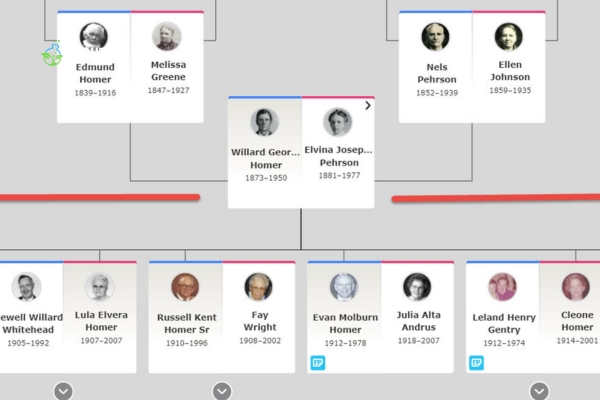
To effectively use DNA for tree building, start by identifying your closest matches and working systematically through your list. Create a research plan that involves contacting matches, comparing family trees, and identifying the most recent common ancestor (MRCA). The MRCA is the point where your family tree and your match’s family tree intersect, representing the ancestor you both descend from.
As more people submit their DNA for testing, the databases grow larger and the results become ever more accurate and expansive. Not only do these tests offer a breakdown of ethnic backgrounds allowing individuals to explore the geographic origin of their forebears, but they can also track migration patterns over generations. This data provides a clearer picture of your lineage’s history and its journey across continents and through time.
Ancestry’s ThruLines tool represents one of the most innovative approaches to automated family tree construction. This feature analyzes your DNA matches alongside publicly shared family trees on the platform to suggest how you might be related to specific matches. ThruLines displays these potential connections as branching diagrams, showing the predicted path from you to your DNA match through common ancestors.
Using ThruLines effectively requires building at least a basic family tree on Ancestry and making it public or searchable. The tool works best when both you and your matches have attached DNA results to trees with some depth. When ThruLines identifies a potential connection, it highlights the specific ancestor it believes you share, giving you a research target to investigate further.
While ThruLines offers exciting possibilities, treat its suggestions as hypotheses rather than proven facts. The tool can sometimes make incorrect connections if family trees contain errors or if multiple ancestors share the same name. Always verify ThruLines suggestions through traditional genealogical research before adding them to your permanent family tree.
23andMe takes a different approach to DNA-based family tree building with its automatic Family Tree feature. Rather than relying on user-submitted family trees, 23andMe analyzes your DNA matches and uses an algorithm to predict your family structure. The tool attempts to place your matches in a visual tree format, showing estimated relationships without requiring you to build a traditional family tree first.
This automated approach is particularly helpful for adoptees or individuals with limited family history knowledge. 23andMe’s algorithm evaluates shared DNA amounts, ages of matches, and shared DNA between matches to predict how everyone connects. The resulting visualization provides a starting point for understanding your genetic relatives, even when you know little about your biological family.
Keep in mind that 23andMe’s Family Tree feature works best when you have multiple close relatives in the database. The tool becomes more accurate as it has more data points to work with. You can improve results by confirming or correcting the predicted relationships as you discover additional information about your matches.
MyHeritage’s Theory of Family Relativity (TOFR) offers one of the most sophisticated approaches to connecting DNA matches with family trees. This tool doesn’t just look at your DNA and family tree; it scans billions of historical records and millions of family trees in the MyHeritage database to find plausible paths connecting you to your matches.
When TOFR finds a potential connection, it presents you with a detailed theory showing the suggested relationship path, the historical records supporting each step, and a confidence level. The tool can sometimes find connections spanning multiple generations and across different family trees, revealing relationships that might take years to discover through manual research.
MyHeritage also provides autoclustering tools that group your DNA matches based on shared DNA patterns. These clusters often represent different branches of your family tree, helping you organize your research and identify which matches belong to specific ancestral lines. Combined with TOFR, these features make MyHeritage a powerful platform for serious genetic genealogists.
Also Read: MyHeritage vs Ancestry 2026 – Which is Better?
With the advent of consumer genetic testing, DNA has become a powerful tool for uncovering family connections. Individuals can receive detailed breakdowns of their genetic makeup by submitting a simple saliva sample to companies such as AncestryDNA or 23andMe. These tests not only provide insights into one’s ethnic heritage but also identify potential relatives within their databases. This revolutionary approach allows people to reconnect with long-lost family members or even discover previously unknown familial ties by comparing their unique patterns of genetic markers against others in the database.
Moreover, these DNA tests leverage advanced algorithms that estimate degrees of relatedness between individuals. When two people’s gene sequences show significant similarities, they are likely related, and such data is showcased through user-friendly interfaces on respective platforms. Users often find close relatives like siblings and parents or more distant relations like third cousins by studying shared segments of DNA. Furthermore, it empowers adopted individuals searching for biological families or genealogists to compile comprehensive family trees with an unprecedented level of detail and accuracy.
Finding biological family through DNA requires patience and methodical research. Start by examining your closest matches and attempting to identify how you connect. Even if close family members haven’t tested, you may find aunts, uncles, first cousins, or half-siblings who can help you piece together your biological relationships. Many adoptees have successfully identified birth parents by working through DNA match networks, even when they started with no family history information at all.
Once you identify a match, reaching out requires sensitivity and clear communication. Remember that not everyone tests for the same reasons – some are curious about ethnicity, others are seeking medical information, and some may not even know they were adopted. Approach contact with respect for their privacy and boundaries, sharing information about yourself and explaining why you believe you are related.
Also Read: How Much DNA Do Siblings Share? Understanding Cousin DNA Sharing
As DNA testing has become mainstream, privacy concerns have moved to the forefront of the conversation. Your genetic data is uniquely yours and cannot be changed like a password if compromised. Understanding how companies store, use, and potentially share your DNA information is essential before submitting a sample.
In 2026, privacy concerns intensified following the 23andMe data breach and the company’s subsequent financial struggles. Millions of users had their personal information exposed, including genetic data, ancestry reports, and in some cases, health information. This incident serves as a stark reminder that genetic databases represent valuable targets for hackers and that company stability affects data security.
Each major testing company has different privacy policies regarding data usage. Ancestry and 23andMe have both stated they do not sell individual genetic data, but they do use aggregated data for research partnerships. FamilyTreeDNA has faced criticism for quietly allowing law enforcement access to their database for criminal investigations. MyHeritage has maintained a stronger privacy stance, explicitly requiring user consent for any data sharing.
To protect your genetic privacy, take advantage of available opt-out features and data controls. Most companies allow you to delete your results or opt out of data sharing for research. Consider downloading your raw DNA data and then removing your sample from company databases once you have obtained the information you need. Using pseudonyms or initials instead of full names can also provide a layer of protection while still allowing you to connect with matches.
The Genetic Information Nondiscrimination Act (GINA) provides some protection against genetic discrimination in health insurance and employment in the United States. However, this law does not cover life insurance, disability insurance, or long-term care insurance. Some states have additional protections, but the regulatory landscape remains inconsistent. Consider these limitations carefully, particularly if you are opting for health-related genetic testing that could reveal predispositions to certain conditions.
Once you have mastered the basics of DNA matching, several advanced techniques can help you break through brick walls and solve complex genealogical puzzles. These methods require more technical knowledge but offer powerful tools for serious researchers.
Triangulation is the process of confirming a shared ancestor by identifying three or more people who share the same DNA segment and can all trace their ancestry to a specific common ancestor. When multiple matches share identical DNA segments and descend from the same person, you have strong evidence that the segment was inherited from that ancestor.
To perform triangulation, you need access to a chromosome browser that shows exactly where on each chromosome you match with other testers. FamilyTreeDNA, MyHeritage, and 23andMe all provide chromosome browsers. GEDmatch offers advanced triangulation tools that work across different testing companies. By comparing segment positions, you can identify groups of matches who share the same ancestor and work together to identify unknown ancestors.
Autoclustering uses algorithms to group your DNA matches based on who shares DNA with whom. Matches who appear in the same cluster likely descend from the same ancestral line, even if you have not yet identified the common ancestor. MyHeritage and GEDmatch both offer autoclustering tools that generate visual charts showing match relationships.
Clustering helps you organize hundreds or thousands of matches into manageable groups. Once you identify the ancestral line for one match in a cluster, you can reasonably assume other matches in that cluster connect to the same line. This technique is particularly valuable for adoptees or people with unknown parentage who need to sort matches by biological family side.
A chromosome browser displays exactly which segments of DNA you share with your matches. Unlike simple match lists that only show total shared DNA, chromosome browsers show the physical location of shared segments on each chromosome. This information is essential for triangulation and helps distinguish between matches who share DNA through the same ancestor versus coincidental matches.
Chromosome browsers become particularly powerful when combined with visual mapping tools like DNA Painter. You can manually map segments to specific ancestors, creating a comprehensive picture of your genetic inheritance. Over time, this mapping helps you identify which segments came from which ancestors, making it easier to place new matches on your family tree.
GEDmatch is a free third-party platform where users can upload raw DNA data from any testing company. This cross-platform compatibility allows you to compare your DNA with people who tested at different companies, significantly expanding your potential match pool. GEDmatch offers advanced tools including chromosome browsers, triangulation, and specialized admixture calculators that provide different perspectives on your ethnicity.
Other valuable third-party tools include DNA Painter for chromosome mapping, Genetic Affairs for autoclustering, and the What Are The Odds (WATO) tool for hypothesis testing. While these tools require more technical knowledge than mainstream testing platforms, they represent the cutting edge of genetic genealogy and can solve cases that stump standard approaches.
Also Read: Best DNA Health Test: Find Your Genetic Wellness Solution!
DNA tests offer a fascinating window into your genetic heritage, providing clues about where your ancestors might have lived and how different branches of your family fit together. By analyzing segments of DNA passed down through generations, these tests can reveal potential relatives you never knew existed, trace migration patterns, and even connect you with distant cousins who share chunks of DNA. This technology can confirm or refute familial connections suggested by traditional genealogical research and provide a broader picture of your roots by combining genetic evidence with historical records.
However, while DNA tests can significantly enhance your understanding of familial links, they are not without limitations. The accuracy and completeness of the data depend heavily on the breadth and diversity of the company’s reference database. If ancestral records from certain regions or populations remain underrepresented in the database, your results may be less precise or leave gaps in your family tree. Additionally, DNA tests do not interpret narratives; they can’t explain historical contexts or personal stories that contribute to family identity. Thus, while invaluable as a tool for genealogy, DNA testing works best when paired with traditional research methods to build a more comprehensive family history.
The relationship between DNA testing and family tree building is collaborative rather than替代. Think of DNA as a powerful flashlight that illuminates connections you might never find in the dark. It confirms relationships, identifies new branches, and sometimes reveals surprises. But the structure of your family tree still requires traditional genealogical research – census records, birth certificates, marriage licenses, and family stories that give meaning to the genetic connections.
Ethnicity estimates provided by DNA tests are best understood as approximations based on current databases and can change over time as more people get tested. These percentages reflect how much of your DNA matches reference populations from specific regions, but they are not definitive statements of your heritage. Updates to company algorithms and reference panels can shift your results significantly, sometimes revealing previously undetected ancestral connections.
DNA testing has the potential to connect you with living relatives who have also taken a test, but it won’t necessarily find everyone. Only people who have submitted DNA samples to the same company or compatible databases appear as matches. Additionally, some relatives may have opted out of matching or used private accounts. The likelihood of finding relatives depends on database size and whether your family members have tested.
DNA results can support lineage claims, but most heritage societies also require historical documentation for membership proof. Organizations like the Daughters of the American Revolution and the Mayflower Society accept DNA evidence as supplementary material, but they still require traditional genealogical proof such as birth, marriage, and death certificates tracing your connection to qualifying ancestors.
Yes, some regions may have less genetic reference data available, making it more challenging for tests to provide detailed insights into ancestry from those areas. Indigenous populations, certain African regions, and some parts of Asia have historically been underrepresented in genetic databases. As testing becomes more global, these gaps are slowly closing, but results for underrepresented regions may still show as broad categories rather than specific locations.
While DNA tests can provide general information about geographical origins and ethnic backgrounds, the results are often broad and cannot pinpoint an exact ancestral hometown. Most results show regional or country-level breakdowns. Some companies now offer more granular sub-regional results for well-tested populations, but genetic boundaries rarely align perfectly with modern political borders or specific villages.
Autosomal DNA tests reliably detect connections within 5-7 generations, or approximately 200-250 years. Beyond that, DNA segments become too small and fragmented to identify reliably. However, Y-DNA and mitochondrial DNA tests can trace direct paternal and maternal lines much further back, sometimes thousands of years, following haplogroup migrations across continents and through prehistoric times.
At approximately 6-7 generations, the amount of shared DNA becomes too small to reliably detect with standard testing. While you may still have genealogical connections to ancestors from 8 or more generations ago, you may not share any measurable DNA with all of them due to random inheritance patterns. Each child receives approximately 50% of their DNA from each parent, meaning some ancestral lines eventually fade from your genetic profile.
For general family tree building, AncestryDNA offers the largest database and ThruLines feature, making it ideal for finding cousins and extending your tree. For deeper paternal or maternal line research, FamilyTreeDNA offers specialized Y-DNA and mtDNA tests. MyHeritage provides excellent autoclustering tools and Theory of Family Relativity. Many serious genealogists test with multiple companies to maximize their match potential.
DNA tests can often help identify biological parents, particularly when combined with traditional genealogical research. Even if a parent has not tested, close relatives such as half-siblings, aunts, uncles, or first cousins may appear in your results. Working backward through these matches, many adoptees and people with unknown parentage have successfully identified biological families. Success depends on how many relatives from your biological family have tested.
Autosomal DNA tests from major companies typically range from $79 to $119 during regular sales, with full-price costs sometimes reaching $99 to $199. Y-DNA and mitochondrial DNA tests are more specialized and cost between $159 and $449 depending on the level of testing. Health and ancestry combination tests generally cost $99 to $199. Most companies offer frequent sales, particularly around holidays, where prices drop significantly.
Digging into your genetic past with DNA tests can be an enlightening journey into your family’s history. While it unveils connections and ethnic origins, it isn’t a magical key that unlocks all ancestral secrets. You’ve got to remember that these tests have their limitations, and the story they tell is often more of a mosaic – pieces of genetic evidence coming together to form a picture that’s open to interpretation.
The beauty lies in combining this new-age science with traditional research methods; it’s an alliance that enriches the narrative of where we come from. Whether you’re using Ancestry ThruLines to discover new branches, exploring 23andMe’s Family Tree for adoptee research, or diving into advanced techniques like triangulation and clustering, DNA testing offers powerful tools for building your family tree in 2026.
Above all, appreciating both what DNA tests can and can’t reveal about our lineage is essential for a realistic perspective as you leaf through the pages of your family tree. Approach your results with curiosity and healthy skepticism, verify connections through traditional research, and always consider privacy implications when sharing your genetic information. The journey to understanding your heritage is ongoing, and DNA testing is just one valuable tool in your genealogical toolkit.


